Simulation is just the first step
An essential part of the structural design is the qualified assessment of fatigue live and durability of structure based on FEA results. DESIGNTEC as partner of MAGNA POWERTRAIN – ENGINEERING CENTER STEYR GmbH & Co KG, the developer of software for fatigue analysis FEMFAT, offers wide range of services which help you to compute and asses fatigue damage of your structures or products in accordance with applicable norms and industrial standards.
Applications of Fatigue Assessment
Proportionally Loaded Components with Constant Load Cycles
Suitable for situations where the structure is subjected to a constant cycle or sequences of non-constant load cycles and the orientation of the principal stresses and strains does not change during the load cycle (proportional loading). The loading situation is typically defined by upper and lower stress states plus one optional constant stress state. The load spectrum can be defined to consider a sequence of non-constant load cycles. The life- or safety factor analysis can be performed using stress- or strain-life models.
Multiaxially Loaded Components
Strength analyses on components with multiple axis loading (directions of principle stresses may change permanently) on the basis of load-time histories from transient FE-analysis (transient based definition) or from multibody simulation / measurement signals (channel based definition). The resulting performance of the structure can be evaluated in term of damage values, endurance safety factors, static safety factors or life time.
Random Response Fatigue
Method designed for fatigue life analysis of multiaxially stochastically loded structures. Analysis is performed completely in the frequency domain, where the loads are defined as power spectral densities (PSDs). The prediction of fatigue life in the frequency domain is more realistic and efficient than time-domain analysis for many applications with random loading such as wind/wave loads, turbulence or shaker tests.
Thermo-Mechanical Fatigue
Applicable to situations where combined thermal and mechanical loading occurs, typically cylinder heads, turbochargers or turbine blades. For the fatigue analysis we use FEMFAT heat module which employs the Sehitoglu Method for the thermo-mechanical low-cycle fatigue. This method takes into account three relevant damage mechanisms – mechanical, environmental and creep damage.
Welds
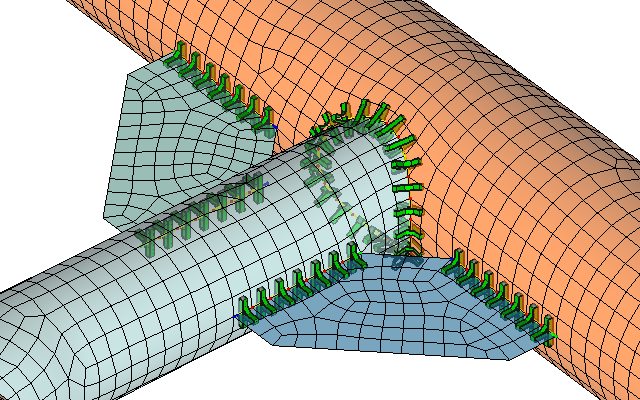
For the fatigue analysis of weld we use FEMFAT weld – a FEMFAT module for assessment of dynamically stressed welds. Analysis of shell, solid and mixed shell-solud welds models can be used. The performance of welds can be evaluated in terms of damage/life or endurance safety factors.
Spot Welds
Fatigue analysis of spot-joints (welds, rivets) in thin sheets based on FEMFAT module SPOT. Both force- or stress-based methods can be used for fatigue assessment.

Frequently asked questions
These are the questions engineers and project managers ask most often before starting a fatigue assessment project: what load data you need to provide, which method applies to your component, and what you actually get at the end. Answered directly, without sales language.
When does fatigue life need to be assessed?
Typically a client comes to us when a component has passed static analysis without issues but is experiencing repeated failures or cracks in service that nobody anticipated.
When loading is repetitive — vibrations, operating cycles, alternating forces. A part can pass static strength without issues and still fail after thousands of loading cycles.
What we do:
- Calculate how many cycles the structure or component will endure
- Identify critical locations where fatigue initiates first
- Work to FKM guidelines, VDI 2230, EN 1993, and other industry standards — including those applicable in the DACH region
Benefit for your project:
- A realistic service life estimate before manufacturing — not just OK / NOT OK
- Problems identified in simulation cost significantly less than problems found in service. If you don’t address this upfront, you address it after the first failure — and the costs are always significantly higher. This is particularly relevant for projects where failure affects production, safety, or the certified service life of the product.
When to act:
Ideally during the design phase — the earlier, the smaller the intervention and the lower the cost. This is not an experiment — this is how development is standardly handled today in automotive and mechanical engineering.
What is the difference between static strength assessment and fatigue life assessment?
Statics tells you whether it holds. Fatigue tells you when it will crack.
What this means in practice:
- Components subjected to vibrations, alternating forces, or operating spectra require both — static analysis alone is not sufficient. This is the standard approach in automotive and the majority of mid-range and high-performance mechanical engineering.
- Fatigue failure develops gradually and without warning — identifying it in advance is critical
What this means for you:
- A complete picture of structural behaviour — not just partial answers
What software do you use for fatigue analysis?
For fatigue life assessment we use FEMFAT — software developed by Magna Powertrain and the industry standard particularly in automotive. We are the official distribution partner for FEMFAT in the Czech Republic and Slovakia.
What this means for your projects:
- Fatigue analysis results are comparable to what the largest players in automotive and mechanical engineering use — this is the standard approach in the industry
- FEMFAT works directly with FEA outputs — no need to recalculate or reformat data between tools
- We have also developed the ACT extension FEMFAT inside ANSYS — fatigue analysis directly in the ANSYS workflow without switching environments, see ANSYS ACT Apps
Can you assess fatigue on structures already in service?
Yes — retrospective assessments are a standard part of our work.
What we address:
- Root cause analysis of damage or failure — why it cracked and where the weak point is
- Residual life assessment when modifying an existing structure
- Retrospective certification or assessment for CE purposes or Prüfstatiker review
Your result:
- Reference project examples can be found in our Reference Projects section
- Specific recommendations on what to change — backed by calculation, not estimates
Can you assess fatigue on structures already in service?
Yes — especially if:
- You’re dealing with warranty claims or repeated failures in service
- You’re planning modifications to an existing structure
- You need to extend the certified service life of a product
What this means for you:
- A retrospective assessment is faster and less expensive than manufacturing a new prototype or running lengthy physical tests
- It naturally connects with FEA Consulting Services — both analyses are often handled within a single project
Not sure where to start? Send us a few sentences about the situation — we’ll give you a specific process proposal. If it doesn’t make sense to address it with simulation or automation, we’ll tell you directly.
We often follow up a one-off project with longer-term collaboration — typically in the area of optimisation or calculation process automation.
Trusted By Companies Like Yours


Is your structure subjected to cyclic loading?
In our team experts for fatigue analysis. We have best-class software, FEMFAT, at hand.
Methods and Technology
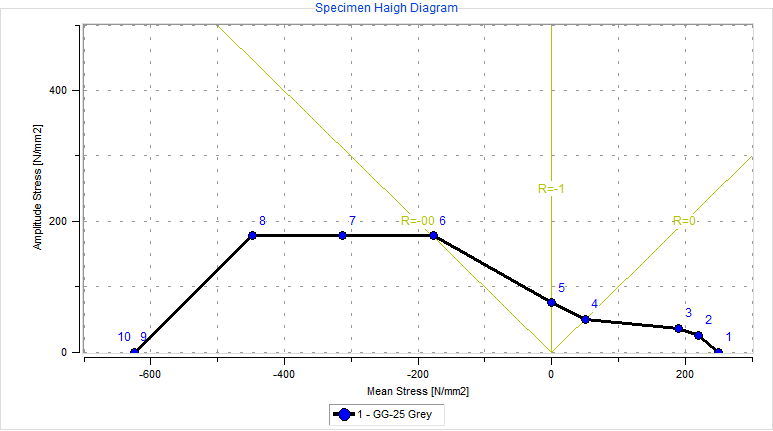
DESIGNTEC offers comprehensive spectrum of fatigue analyses based on technology and methods implemented into software for CAE based fatigue analysis FEMFAT:
- High-Cycle Fatigue (Stress-Life model),
- Low-Cycle Fatigue (Strain-Life model),
- Critical plane and stress computation,
- Rainflow counting,
- Neuber rule (elasto-plastic stresses based on a linear elastic FE analysis),
- Miner rule (damage summation),
- Safety factor analysis,
- Material generation (the creation of a new material based on the definition of a material class and certain material parameters in tension).
We can consider many interacting fatigue influences in the analyses:
- Notch influence (by relative stress gradient)
- Mean stress influence
- Influence of surface roughness
- Technological parameter influence
- Tempering condition
- Technological surface treatment (Shot peening, Rolling, Carburizing, Nitriding, Carbonitriding, Induction hardening, Flame hardening)
- Temperature influence
- Statistical influence
- Forging influence (technological factor)
- Cast microstructure
Material Models and Material Properties
The material properties for material models we defined based on
- industrial standards (German FKM guideline, EC3),
- comprehensive FEMFAT material database with over 500 material data sets,
- FEMFAT material generator,
- custom values from your material tests.