
We Deliver FEA Results You Can Build On
We calculate what your design needs to withstand — from linear stress analysis to nonlinear fatigue assessment with ANSYS.
We assess structural integrity and verify strength based on industrial standards, including fatigue analysis using FEMFAT.
Our team brings 17 years of experience.
Our services at a glance
Structural & Stress Analysis

Dynamic & Vibration Analysis

Assessment and Strength Verification
Why Engineers Work With Us
17 years
we have been solving FEA problems with ANSYS
200+
FEM projects we have already delivered
30+
companies in DACH region trust our work
64€/Hourly rate
of our FEA simulation with ANSYS. We charge fairly because we work efficiently.
Frequently asked questions
These are the questions engineers and project managers ask most often before starting an FEA project: what data you need to provide, how long it takes, and what you actually get at the end. Answered directly, without sales language.
Does FEA make sense for smaller projects?
Yes — especially when you don’t want to risk manufacturing or putting a component into service blind.
It makes sense especially when:
- You’re working on a specific problem or doubt about a design
- Physical testing is costly or time-consuming
- An error would mean reworking a prototype, a warranty claim, or a safety risk
What this means for you:
- Simulation pays off even for one-off questions — the cost of the calculation is a fraction of the cost of manufacturing and test-and-error prototyping. Relying on internal estimates or waiting for a prototype typically extends the development cycle and shifts the cost of errors to a later, more expensive project phase.
Not sure whether it makes sense in your case? A few sentences or a rough description is enough — you don’t need complete documentation.
We’ll give you a specific process proposal, indicative scope, and a recommendation on whether it’s worth pursuing. If it doesn’t make sense, we’ll tell you that too.
The decision is always yours — we give you the basis to make it with confidence.
What exactly do I receive at the end?
We don’t just deliver numbers.
You get:
- A technical report with calculation results — in English, German, or Czech
- Interpretation of results in the context of your design intent
- Specific recommendations — what to change, where to reinforce, where you can reduce weight
What this means for you:
The report is suitable for review by a German Prüfstatiker if your project requires it. Such outputs are standard requirements in the DACH region.
You know exactly what to change and why. Based on this you decide: revise the design, move to production, or explore further variants.
How long does an FEA project take?
It depends on geometry complexity, the number of load cases, and the required level of accuracy.
What this means in practice:
- A simple assessment or partial analysis — results within a few days. First meaningful results often within the same week.
- Complex model, parametric studies, or multiple variants — on the order of weeks
- A precise estimate is provided after reviewing the inputs
Benefit for your project:
- A specific timeline and description of what you’ll receive at each stage of the analysis. The standard approach via physical prototypes takes more time and costs more on each iteration — in simulation you get the answer much sooner.
When to act:
Don’t wait for a physical prototype. An error found in simulation costs a fraction of what an error found on a prototype costs. This means you have clarity within days — not weeks or months of physical testing.
What data do you need to start an FEA analysis?
Typically a client comes to us when a design has gone through development but it’s unclear whether it will hold up under real-world loading — and physical testing would be too costly or time-consuming.
Send us the CAD model, information on materials, loads, and boundary conditions, and tell us what you want to verify — strength, fatigue, deformation, dynamic response.
What we’ll do:
- Review the inputs and propose a calculation approach
- If anything is missing, we’ll tell you exactly what and how to provide it — we don’t start blind
Your result:
- A clearly defined project scope and deliverable before any work begins
- No surprises mid-project
When to act:
When you’re unsure whether your design will hold under real loading. Errors found in simulation cost a fraction of what errors found on a prototype or in service cost. This is exactly the moment when it makes sense to bring us in.
Do you deliver only results, or also a solution proposal?
Both of them.
What we do:
- Identify weaknesses in the design
- Propose specific design modifications — reinforcement, geometry changes, weight optimisation
- If the project requires repeated analyses of a similar type, we can automate the entire process — see [ANSYS Customization]
Benefit for your project:
- Faster development and fewer dead ends
- In the case of automation — the same analyses next time run without manual effort
Not sure whether it makes sense in your case? A few sentences or a rough description is enough — you don’t need complete documentation.
We’ll give you a specific process proposal, indicative scope, and a recommendation on whether it’s worth pursuing. If it doesn’t make sense, we’ll tell you that too.
The decision is always yours — we give you the basis to make it with confidence.
Trusted By Companies Like Yours


Accelerate Innovation – FEM Calculation Services from €64/hour
From structural to thermal simulations: we help you validate, optimize, and bring designs to market faster.
Fair pricing: starting at €64/hour for FEM calculations with ANSYS.
Finite Element Analysis (FEA) – an Approach for Optimal and Safe Design
Finite Element Analysis (FEA) and numerical simulations form an integral part of the product and structure development process in various industries. Benefits of FEA:
- prove and assess structural integrity, fatigue life and durability prior to manufacturing,
- extend the knowledge of structure response in real conditions,
- minimize cost of materials and maximize product performance (virtual product development),
- reduce product design time and time-to-market,
- reduce expensive physical prototype manufacturing and testing.
FEA as applied in engineering on a wide spectrum of complex engineering problems is a tool used for the evaluation of structures and systems, providing an accurate prediction of a component’s response subjected to a load condition and proof of reliability as well as durability of the product or structure.
The application of modern numerical simulations tremendously helps in minimizing your costs, improving the product or structure and hence in maintaining and improving your competitiveness.
Related Topics
-

Fatigue Assessment
Predict and mitigate fatigue failure using proven FEA methods. Our FEA experts use advanced fatigue analysis tools to assess life cycles and improve structural integrity.
-

Virtual Product Development & Optimization
Our FEA consulting engineers work with you through the full development cycle — leveraging optimization algorithms and simulation to reduce cost and boost reliability.
FEA Simulation Services for Every Industry
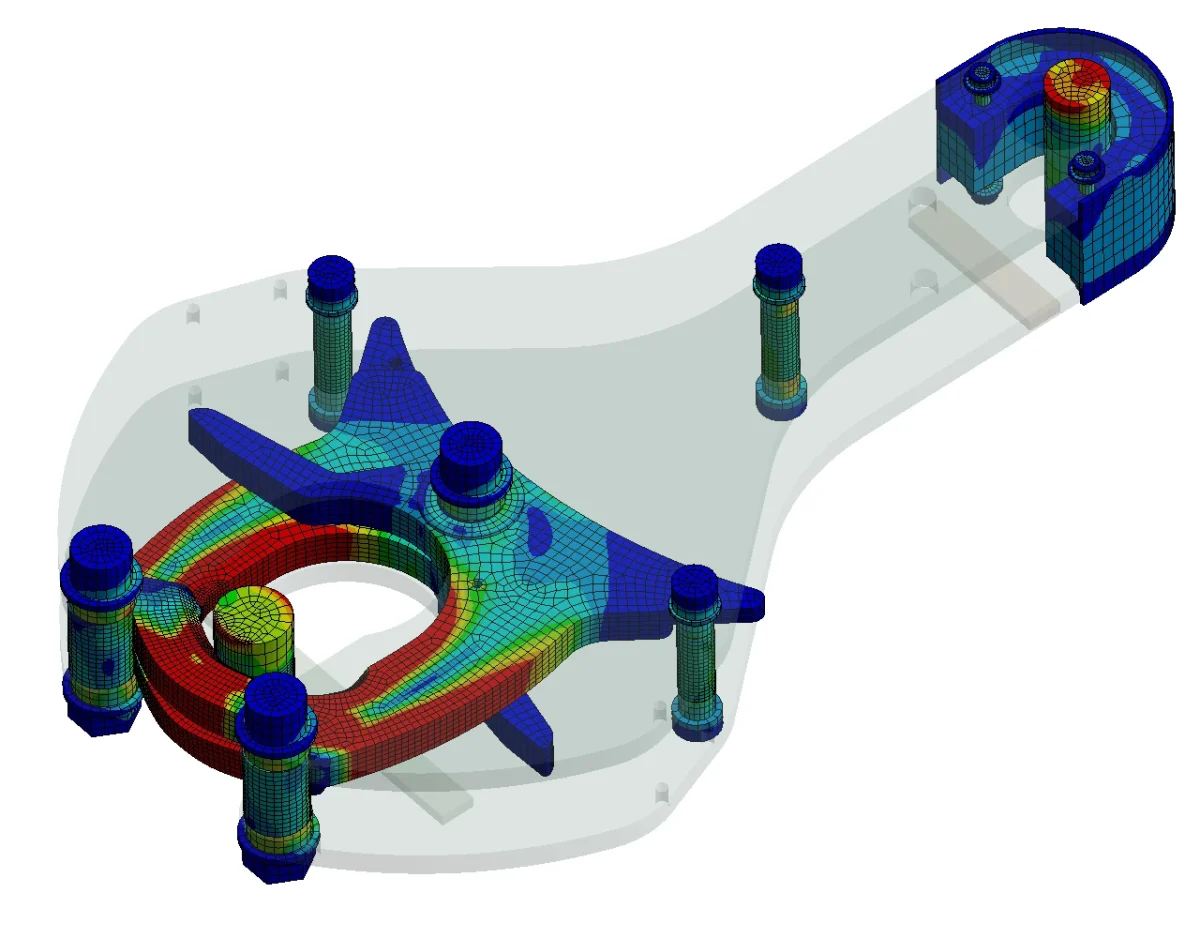
Structural & Stress Analysis
DESIGNTEC provides structural FEA consulting services to customers that need static design of complex structures where standard technologies may be insufficient for analysis and explanation of the conditions and behavior of a civil structure or mechanical device.
Our expertise includes advanced capabilities such as modeling material nonlinearity (plasticity, creep), handling large deformations, predicting stability and buckling under critical loads, and performing nonlinear contact analysis for complex interactions between components.
Read more about our services
FE-Analysis can be effectively applied to investigate structural integrity of individual component as well as performance of whole structure under service and extreme conditions. Static structural analysis can be used for limit state design or for advanced modeling of real structure behavior under extreme loading conditions where the nonlinear behavior of structure components plays crucial role. In such cases nonlinear FE-Analysis provides insight into possible mechanisms of failure and helps to improve the structural performance.
There are many physical aspects that can be considered during simulation process:
- Geometrical nonlinearities (stress stiffening large displacements, large strains).
- Material nonlinearities (Metals, plastics, rubbers, foams, composites, fluid, reinforced concrete, fiber reinforced concrete, timber, soil and rock). Composite laminates with per ply definition.
- Extensive failure and yield models. Time, rate and temperature dependent material properties.
- Nonlinear contact behavior.
- De-lamination, crack propagation.
- Linear and Non-linear stability analysis considering structural imperfections.
- Material creep and shrinkage.
There is variety of applications:
- Linear and Nonlinear analysis of civil engineering structures and mechanical constructions.
- Soil-Structure Interaction analysis.
- Simulation of nonlinear response of materials and structures and machines.
- Ultimate and serviceability state design for steel and reinforced concrete structures based on FE-Analysis, simulation of experimental tests.
- Geo-mechanical and Geo-technical simulations.
- Nonlinear behavior of reinforced and fiber-reinforced concrete.
- Stability of rock/soil slopes (limit equilibrium methods, continuum and discontinuum numerical methods).
- Analysis of the sequential construction (civil engineering, geo-technics etc.).
- Above and underground storage tanks.
- Assessing the structural safety of building structures subjected to fire loading.
Dynamic & Vibration Analysis
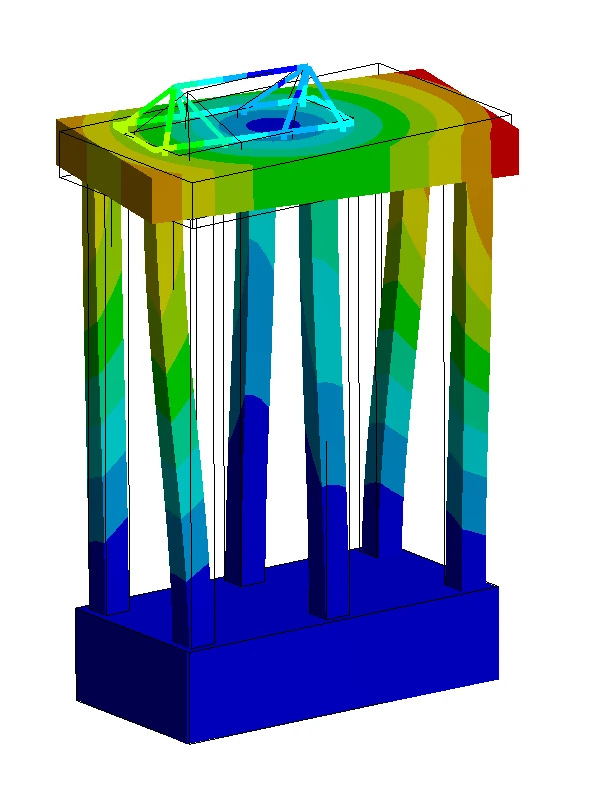
Through a deep understanding of structural behavior subjected to dynamic loading, it is possible to obtain improvements into the operating efficiency of a product, and to reduce probability of failures, shutdowns and minimize maintenance costs. Vibration analysis and FEA technique can be effectively used to evaluate the dynamic characteristics of machines and structures prior to fabrication or for troubleshooting of installed systems.
Dynamic structural analysis helps to avoid resonance effects and excessive vibration of the structure at design stage. To ensure structural integrity and serviceability of all structural components we design tuned vibration absorbers, passive vibration isolators and active vibration control systems.
Furthermore, simulation of accidental dynamic conditions such as heavy wind, earthquake, vehicle/aircraft impact or explosion can be used to investigate structural integrity during such disasters.
We provide structural analysis services ranging from simple modal analysis to complex nonlinear transient analysis.
Read more about our services
There are more analysis options depending on the problem physics:
- Modal analysis.
- Harmonic analysis (resonance problems).
- Transient dynamic analysis of linear and nonlinear systems (random excitation, impulse, moving loads, etc.).
- Response spectrum analysis (single point and multi-point spectra).
- Nonlinear explicit dynamics (short duration events as impact, crash and explosion).
- Random vibrations and PSD.
- Signal processing (DFT, FFT, filtering)
There is variety of applications:
- Analysis of vibrations caused by rotating equipment under operation conditions as well as during startup and shutdown conditions.
- Structures subjected to wind load (cable-supported structures, membrane roofs, towers and masts, multi-storey buildings).
- Fluid-structure interaction and flow induced vibrations (pumps, pipe systems, storage facilities).
- Earthquake engineering.
- Failure, Fatigue and Fitness for Service analysis of machine components, bearings, platforms, floors, connected piping systems, electronic devices and other auxiliary equipment.
- Structural vibration troubleshooting (modification of the vibration source and transfer or the structure mass/stiffness, design of passive and active vibration control systems, vibration insulation).
- Foundation design and soil structure analysis for rotary, reciprocating and impact machines.
- Vibration control systems for human comfort, sensitive devices and accurate production processes.
- Seismic design of equipment and machinery systems.
- Rotordynamic Analysis.
- Flexible and rigid Multi-body Dynamics.
Assessment and Strength Verification – FEA & Structural Analysis
Strength verification and structural assessment are critical steps in the engineering design process. At DESIGNTEC, we provide expert Finite Element Analysis (FEA) and fatigue strength verification to ensure your components meet the highest standards of safety, durability, and compliance.
Our services include:
- Fatigue Strength Analysis using advanced FEMFAT software
- Bolted Connection Assessment for secure and reliable joints
- Welded Joint Evaluation to guarantee structural integrity
Read more about our services
We perform calculations and simulations according to leading engineering standards and guidelines, including:
- EuroCodes and DIN Standards
- FKM-Richtlinie for fatigue strength
- VDI 2230, ECSS-HB-32-23
- ČSN and others applicable norms
With our expertise in CAE consulting, FEA simulations, and strength verification, your design will comply with international standards and deliver long-term performance.
Reference Projects
-

-

Dynamic Analysis and Fatigue Life Prediction of Reinforced Concrete Chamber for Testing of High Explosives
-

Stress Analysis and Fatigue Live Prediction of a Disc Brake System
Within the scope of an innovative vehicle brake system development a non-linear static contact analysis and fatigue assessment was performed.
-

Static Analysis of Railway Bridge OSKAR during Construction and Parametric Study on Uncertain Model
The primary objective of the presented project was to determine the static response of the Railway Bridge OSKAR steel structure during the construction phases.